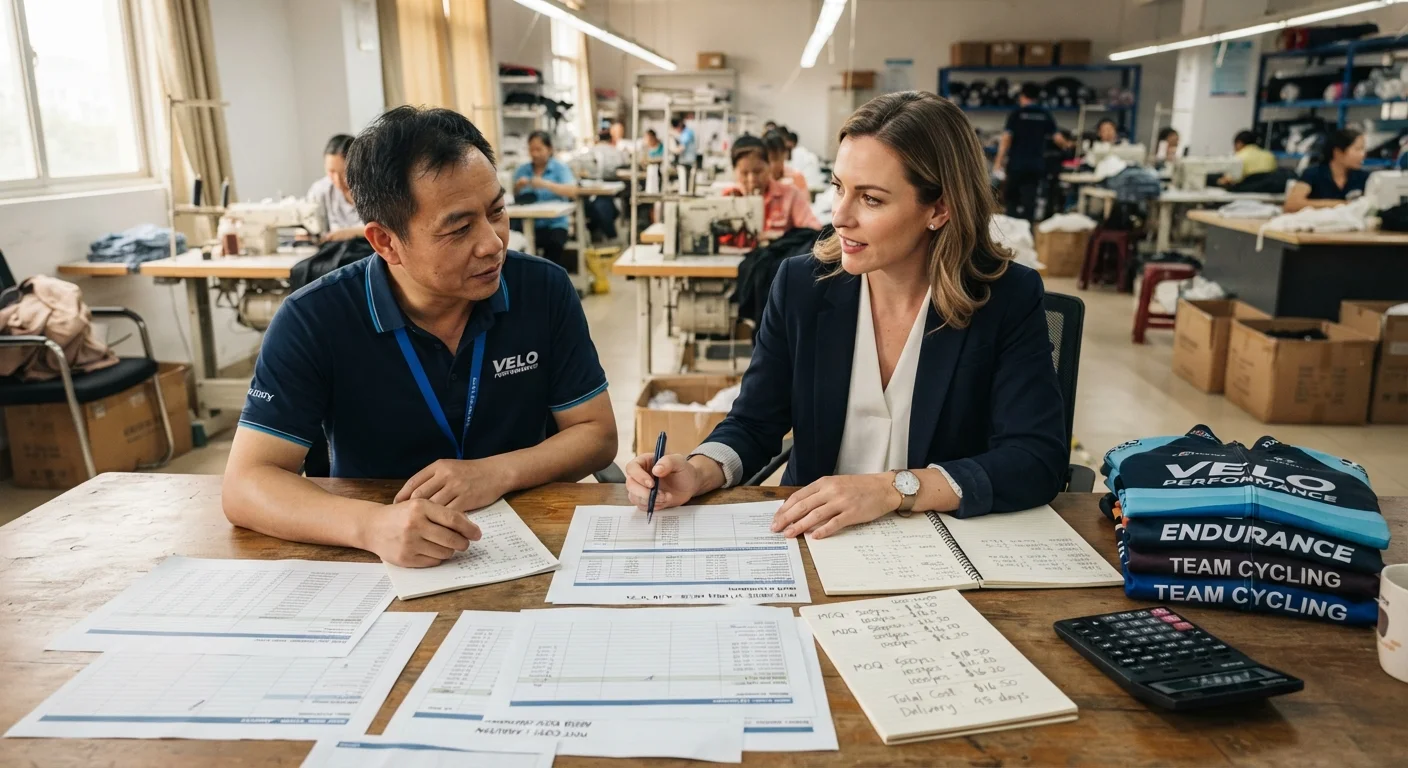
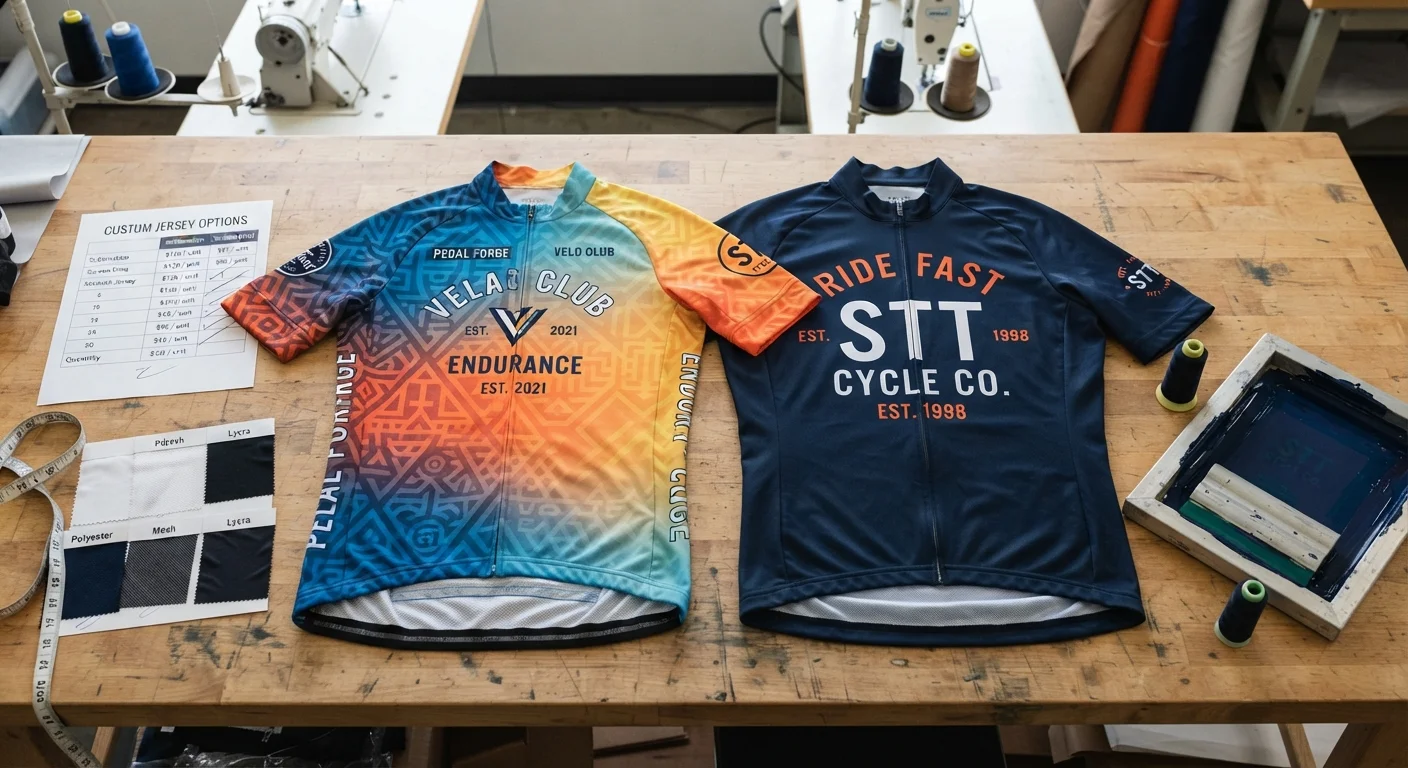
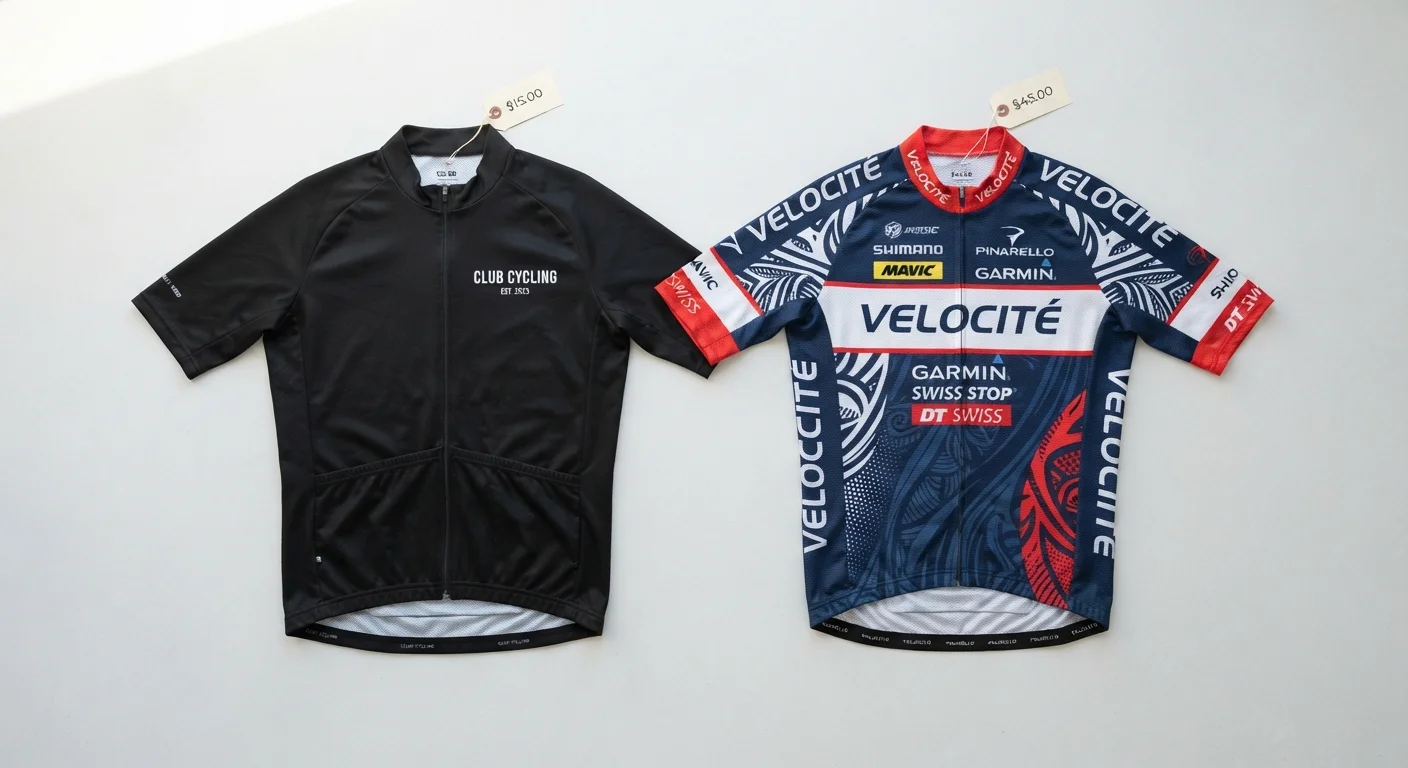
A cycling club treasurer wires a 30% deposit—$4,200—to a "factory" found on Alibaba. Three weeks later, the WeChat account goes silent. The website disappears. The jerseys never existed.
This happens more often than anyone admits, and it's why you're vetting candidates before you commit real money to a China cycling jersey manufacturer.
You've scrolled through dozens of supplier profiles. You know the sales pitches by heart. What you still need: a reliable way to tell legitimate factories from trading companies pretending to be one, plus a script for demanding proof without sounding paranoid.
That's what this framework gives you—checklists, copy-paste messages, and red-flag triggers that seasoned buyers use to confirm a custom cycling jersey supplier can actually deliver before a single dollar leaves your account.
The Real Cost of Skipping Factory Verification (A Cautionary Tale)
The treasurer skipped five checks that take fifteen minutes total. That lost the money.
The company name shifted between the invoice, the WeChat profile, and the "factory" website. A business license photo never materialized despite three requests. They demanded 100% upfront payment with no split or negotiation. Every video call request got postponed, then ignored.
Any single one of these should stop a deal cold. All four together means it's a trading company wearing a factory's name, or worse, a name that doesn't exist at all.
The fix isn't complicated. Confirm the registered business name matches every document. Verify the bank account belongs to that same legal entity. Request a live walkthrough before wiring anything. Real China sportswear factory operations welcome live walkthroughs.
Step 1: Verify Manufacturer Status
Two Chinese characters separate a factory from a middleman: Production versus Trade.
Request the supplier’s business license and look for manufacturing terms: (production), (manufacturing), (processing), (assembly). If you see (trade), (wholesale), or (import/export) instead, you’re talking to a reseller, not a cycling jersey manufacturer.
Verification checklist:
Get the full Chinese legal name and 18-digit Unified Social Credit Code. Cross-check both against China’s official business registry. Confirm the business scope, legal entity name, and registered address match.
Ask for certificates issued in the supplier’s own name. Traders borrow factory certificates from someone else’s production line.
Request a live video walkthrough. Machines running, workers at stations, QC area visible, and signage that matches the company name.
Check the registered address. An industrial park likely means a real factory. A downtown office tower likely means a trading company.
Compare the product scope. A specialist cycling apparel factory sticks to narrow, technical product lines. A trader sells everything under the sun.
One more tell: ask for their VAT invoice type. Manufacturers typically invoice at a higher rate than small trading outfits. That alone isn't proof, but stacked with the rest, it tightens the picture fast.
Step 2: Conduct a Live Video Factory Audit (Without Visiting China)
Skip the highlight reel. Demand the raw footage live.
A five-minute prerecorded video only proves someone can hold a phone steady in a room that might not even be theirs. A real China cycling jersey manufacturer will walk you through the whole operation, camera rolling, no cuts, no edits.
Your continuous walkthrough route:
Front gate with signage matching the business license
Reception
Production floor with machines running and workers present
Raw-material warehouse
QC and testing station
Finished-goods warehouse
Packaging area
Ask them to show a current order in progress, not idle sewing machines staged for the call. Semi-finished jerseys. Active work orders. Someone cutting sublimation fabric.
Match the story to the scene:
Count the workers. Compare that number to the "large-scale production" they promised in chat. A factory claiming 5,000 units monthly with three people on the floor? That's your answer.
Questions to fire off live, no warning:
How many production lines run right now?
What's your standard MOQ for a cycling jersey manufacturer like this?
Can I see your QC bench and defect log?
Will you accept a third-party inspection?
Real factories answer fast. Traders stall, redirect, or blame a bad connection when you ask to see the warehouse.
Step 3: Validate Sample Quality Against Industry Benchmarks
A sample that "looks good" means nothing without a benchmark to measure it against. Eyeballing stitching and hoping is gambling with your production budget.
Professional buyers use AQL-based acceptance sampling , defined under ISO 2859-1. AQL stands for Acceptable Quality Level—essentially the worst tolerable defect rate a sampling scheme will still approve most of the time.
Standard AQL benchmarks for cycling jersey fabric quality:
0% for critical defects (safety issues, wrong sizing that makes the jersey unwearable)
2.5% for major defects (sublimation printing misalignment, color bleeding, seam puncture)
4.0% for minor defects (loose threads, minor fabric puckering)
You'll see standard AQL index values on inspection reports too: 0.65, 1.0, 1.5, 2.5, 4.0, 6.5. Lower numbers mean stricter tolerance.
The sampling plan pulls a sample size based on your lot size and inspection level. That sample gets compared against a fixed defect-count limit. Exceed it in any category, and you reject the entire batch—no negotiation.
For measurable specs like sleeve length or waistband elasticity, ask your custom cycling jersey supplier to run ANSI/ASQ Z1.9 variables inspection instead. It uses actual measurements, not just pass/fail counts, giving tighter accuracy on fit-critical dimensions.
Never accept a lot without agreeing on AQL thresholds before production starts.
Step 4: Design Safe Payment Terms (Avoiding Deposit Loss)
Money talks first. Structure it wrong, and you're funding someone else's vacation.
The industry-standard split is 30% deposit, 70% balance before shipment. The deposit covers materials and labor. The balance stays locked until you've confirmed the goods are right.
If you are new to this supplier, push for a safer variant: 30% at PO, 40% after sample approval, 30% pre-shipping. That gives you three checkpoints instead of one, and less cash is exposed if something goes sideways early.
Never wire 100% upfront. Ever. This single rule prevents most deposit-loss horror stories.
Payment Method Hierarchy
Trade Assurance or Escrow: Alibaba holds funds until you confirm receipt, plus 30 extra days for disputes. Best protection for first orders.
T/T (wire transfer): Standard for established relationships. Pair with 30/70 split and inspection triggers.
Letter of Credit (sight L/C): Bank releases payment only against matching documents — bill of lading, packing list, inspection certificate. Reserve this for larger, higher-value orders after trust is built.
Red Flags That Should Stop You Cold
Payment requested to a personal account instead of the registered company account
Beneficiary name doesn't match the business license
No willingness to tie balance payment to a passed pre-shipment inspection
Verify any new bank account through a phone number you sourced independently, not one from their invoice or chat.
Put every term in writing. The deposit split, inspection condition, and bank details belong in the PI or contract. Not a WeChat message that can vanish along with the supplier.
Step 5: Use Third-Party Inspection to Confirm Shipment Quality
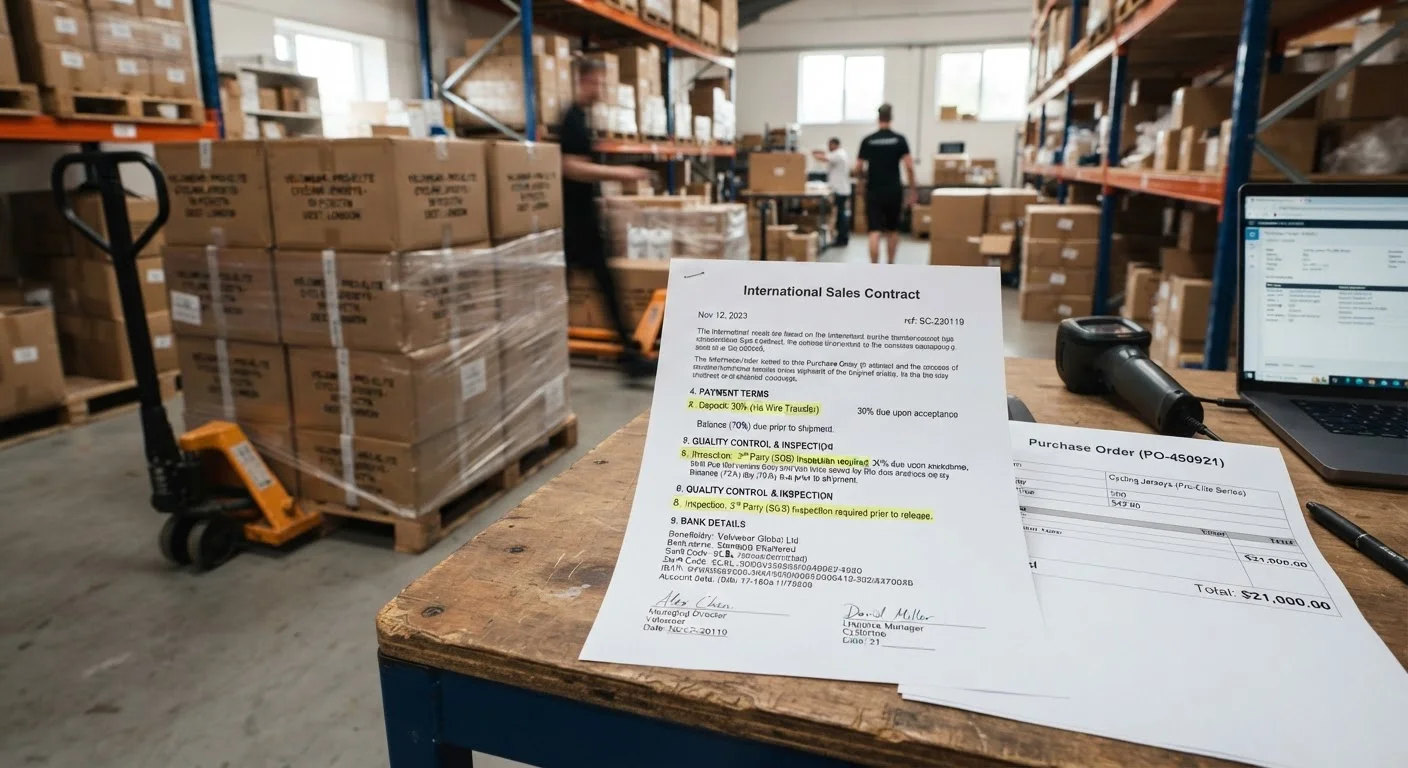
Your goods are packed. The factory says "ready to ship." That's exactly when things go sideways if nobody checks.
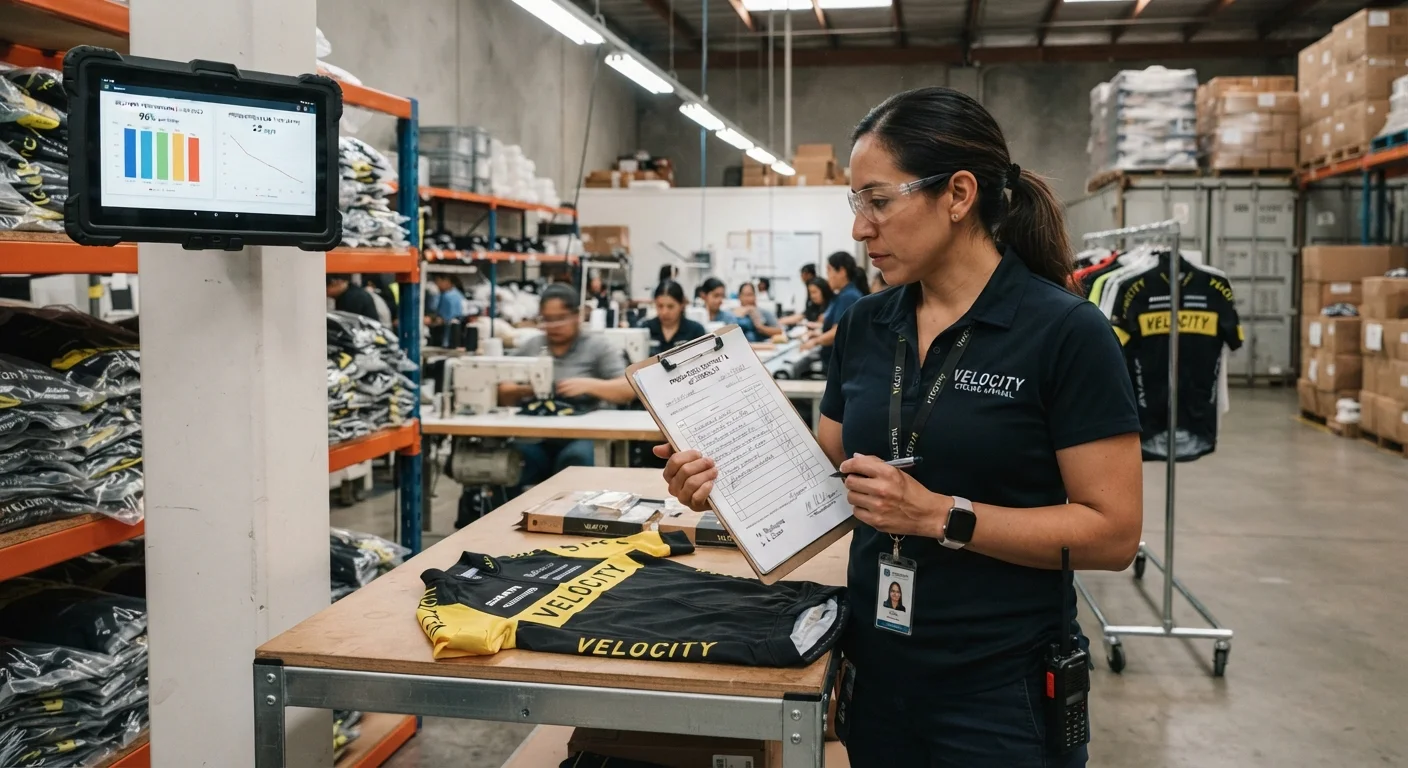
A pre-shipment inspection (PSI) is a random check on finished jerseys before they leave the warehouse. Inspectors verify quantity, workmanship, function, labeling, packaging, and whether the shipment actually matches your specs.
SGS, TÜV SÜD, QIMA, and HQTS all run PSI for cycling apparel.
For a 1,200-unit order at General Inspection Level II, the sample size is 80 units. You can accept up to 5 major defects and must reject at 6 or more. Minor defects: accept up to 7, reject at 8 or more. Any critical defect means automatic rejection.
Most buyers apply a quantity tolerance of ±3% of the PO to pass, and reject if the shortfall goes over 5%.
Write the inspection scope, acceptance criteria, and rejection consequences into your contract. A verbal promise from a China cycling jersey manufacturer means nothing once the container's sealed.
Step 6: Evaluate Production Capacity and Lead Time Reliability
A quoted lead time means nothing without proof it holds under pressure. Ask for the last 12–24 months of PO history, including on-time delivery rate, on-time-in-full rate, and lead time variance by product line.
Benchmarks that separate reliable factories from risky ones
On-Time Delivery (OTD) : 95%+ is competitive, 98%+ is world-class. Below 85% means real supply risk.
On-Time In-Full (OTIF) : 95–98% signals strong performance for a bulk cycling jersey production run.
Lead time variance : Best-in-class factories sit under 8%. Average SMB vendors run 22–30%.
Push for specifics like available machine hours, current line load, and whether your order fits without bottlenecking existing work. Ask if the quoted lead time reflects finite scheduling or just a rough guess.
Repeated date pushes matter more than one late shipment. That pattern predicts your next order's headache.
Step 7: Understand Your MOQ and Cost Structure
MOQ numbers get thrown around like they're fixed law. They're not. Most negotiation happens in the gap between "stated minimum" and "what actually works for both sides."
Typical ranges for a China cycling jersey manufacturer:
Basic knit tees: 50–100 units per color
Complex outerwear or technical jerseys: 300–500 units
Many bulk cycling jersey production runs start at 500–1,000, with trial orders sometimes negotiated down to 100–500 if you show growth potential
The real number you need is landed unit cost. Add unit price, freight per unit, import duties, and storage cost. That's your true cost, not the invoice quote.
Run the break-even math: fixed costs ÷ (sale price − production cost). Fixed costs of $30, selling at $5, producing at $1? Break-even lands at 7.5 units. Order 9, and you're clearing $6 margin on $45 revenue against $39 total cost.
Volume moves pricing fast. Unit cost typically drops 20–30% past 500 pieces, with the strongest break usually sitting at 1,000+.
Step 8: Cycling Apparel Factory (Cyclingapparelfactory.com) — Integrated OEM/ODM Partner
Some cycling manufacturer suppliers scatter. This one consolidates.
Cyclingapparelfactory.com positions itself as a full-stack OEM/ODM cycling apparel manufacturer that handles pattern development, sample-to-bulk production, private-label branding, and export support under one roof. Product range covers road jerseys, MTB jerseys, bib shorts, jackets, and base layers.
Benchmarks to verify against their claims:
MOQ: 50 pcs/style for startup programs, or 1,000+ pcs/color for established runs
Timeline: 7-day digital proof, 14-day sample, 28–42 day bulk production
Certifications to request: ISO 9001, OEKO-TEX Standard 100, BSCI/Sedex, WRAP, SA8000
Ask for direct factory contact: email, WhatsApp, physical address. If they dodge specifics on export markets served or certification copies, apply the same Step 1 verification protocol before committing.
Step 9: Compare Shortlisted Candidates Using the Verification Scorecard
Gut feeling picks losers. A scorecard picks winners.
Build a weighted matrix and score every shortlisted China cycling jersey manufacturer on identical criteria. Same rows, same weights, no exceptions—that's what makes the final call defensible when someone asks why you chose Factory A over Factory B.
Weighted criteria that matter most:
Quality/performance (defect history, sample results): 25%
Delivery reliability (OTD, capacity, recovery plan): 20%
Commercial fit (pricing, payment terms): 20%
Compliance/risk (certifications, insurance, audit findings): 20%
Operational fit (communication, MOQ flexibility, onboarding): 15%
Rate each on a 1–5 scale, multiply by weight, sum the total. But set a deal-breaker gate first: missing business license, refused video walkthrough, or no third-party inspection acceptance disqualifies a supplier regardless of score.
Attach evidence to every row—sample photos, PSI reports, PO history. Score documentation, not memory.
Outcome labels:
Green (≥90%): approve, start negotiating volume
Yellow (75–89%): request corrections before committing
Red (<75%): eliminate, move to next candidate
Step 10: Communication Scripts for Key Negotiation Stages
Whoever asks the most questions usually wins the negotiation. Most buyers forget that and let the China cycling jersey manufacturer control the entire conversation.
Opening line that sets the tone:
"We appreciate your continued partnership and want today's discussion to focus on mutual value. Based on our cost analysis, we see room to optimize pricing while holding your quality standards. Walk us through your current cost drivers?"
Price anchor:
"Our should-cost model suggests a target price near $X per unit, reflecting raw material costs and manufacturing efficiency."
Trade-off offer:
"If you cut lead time by 10%, we increase order volume by 15%. Feasible?"
Closing deadline:
"To hold our production schedule, we need a firm price commitment by Friday."
When they push back on discounts, use C.L.O.S.E. —Connect, Listen, Outline, Solve, End: "What would you remove from scope to make that work?"
After verbal agreement, send a close-out email covering final pricing, deliverables, milestone dates, and contact details for both sides. Skip vague lines like "let's talk soon."
Conclusion
A ghost factory swallowed that 30% deposit. It didn't have to happen. Every horror story in this guide traces back to one missing step: verification skipped in the rush to place an order.
A real China cycling jersey manufacturer proves itself with business licenses, live video walkthroughs, and third-party inspection reports. A trustworthy custom cycling jersey supplier welcomes your questions about MOQ, payment terms, and fabric testing.
You need a system to filter the suppliers you already have.
So pull out that verification checklist. Run it against your top 2-3 candidates this week. Send the video audit request script today — before you wire another dollar.