A 12% return rate on one production batch. That's what it cost a mid-sized cycling brand when their Custom Women'S Cycling Jackets manufacturer graded down a men's pattern to call it a "women's fit." The culprit: an unadjusted armscye that pinched at the shoulder and a chest cavity that left zero room for movement. Technical failures that no amount of marketing copy could fix.
If you're sourcing custom women's cycling jackets and need to tell whether a factory actually understands female-specific pattern engineering, or just relabels men's blocks in smaller sizes, this is the technical breakdown you need. We'll walk through the exact anthropometric variables that separate a properly engineered women's cycling jacket cut from a resized men's shell: dart placement logic, waist-to-hip differential calculations, sleeve ratio adjustments, and the layering decisions that determine real-world thermal performance. By the end, you'll have a concrete checklist to hold any manufacturer accountable to.
Why Custom Women's Cycling Jackets Require Different Cuts: The Anthropometric Differences
Numbers don't lie, and cycling apparel size charts prove the point better than any sales pitch. Take Liv's women's range: an XS runs chest 76–81 cm, waist 58–64 cm, hip 84–89 cm. Scale up to XL and you get chest 99–107 cm, waist 81–89 cm, hip 107–114 cm. That's not a linear grade-up. Another women's cycling size guide shows the same non-proportional spread: chest 78–102 cm, waist 61–85 cm, hip 88–112 cm across the size run. This is why women's cycling jacket sizing can't follow a men's chart shrunk down by a percentage.
The fit triangle explains why straight tubes fail. One women's size chart plots bust 84–99 cm against waist 65–81 cm against hips 87–105 cm. That gap between bust and waist, and again between waist and hip, is the anthropometric signature that demands darts, contour seams, or side-panel shaping, not a boxy unisex silhouette. Standard measurement protocol backs this up: fit is taken at the fullest chest, narrowest waist, and widest hips, never a single circumference number.
Torso length changes the whole pattern block. Jackets and vests require chest plus waist plus torso length as separate inputs. Torso, properly measured, is the vertical loop from shoulder top over the bust, through the legs, back to start – a female-specific loop that has no equivalent in men's block construction.
For any Custom Women'S Cycling Jackets manufacturer producing custom cycling apparel, the actionable cut changes read like a checklist:
Narrower shoulder slope and shoulder width
Additional bust room without added waist bulk
A nipped, shaped waist
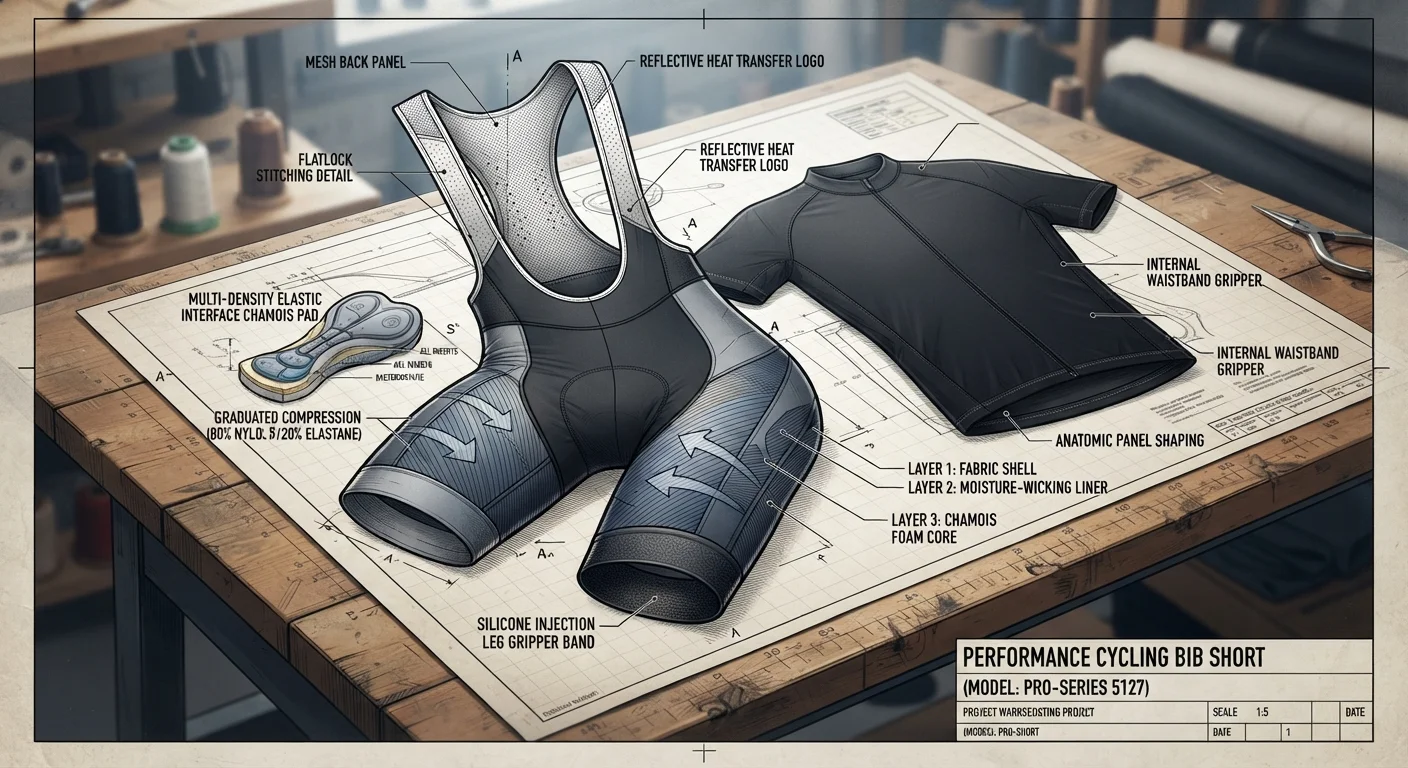
Hip allowance to stop hem ride-up during riding position
Shorter sleeve and body length
A production spec built on bust/waist/hip ratios plus torso length, not size-up increments from a men's pattern, is the only foundation that holds up in real fit testing.
Key Fit Parameters: Chest Dart Angle, Waist Suppression, and Sleeve Length Ratios
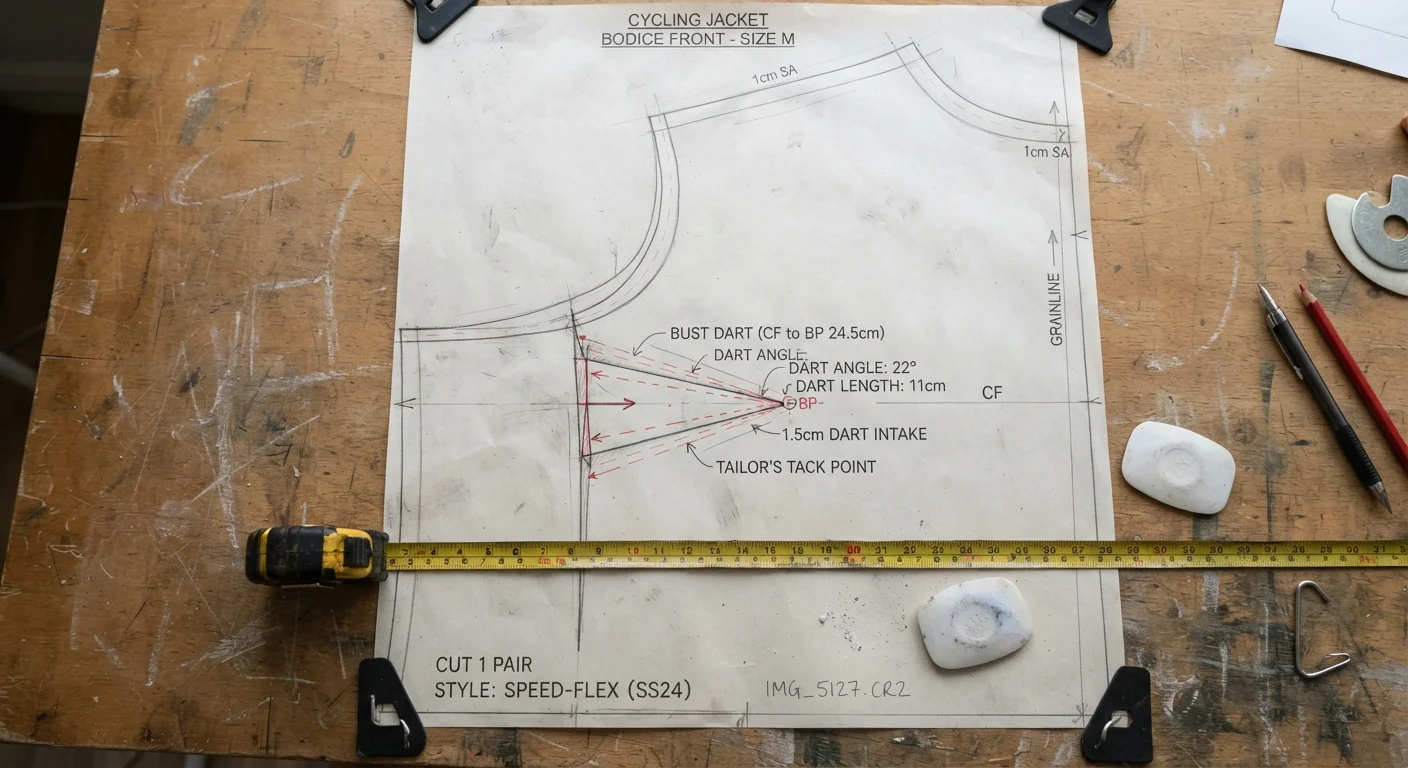
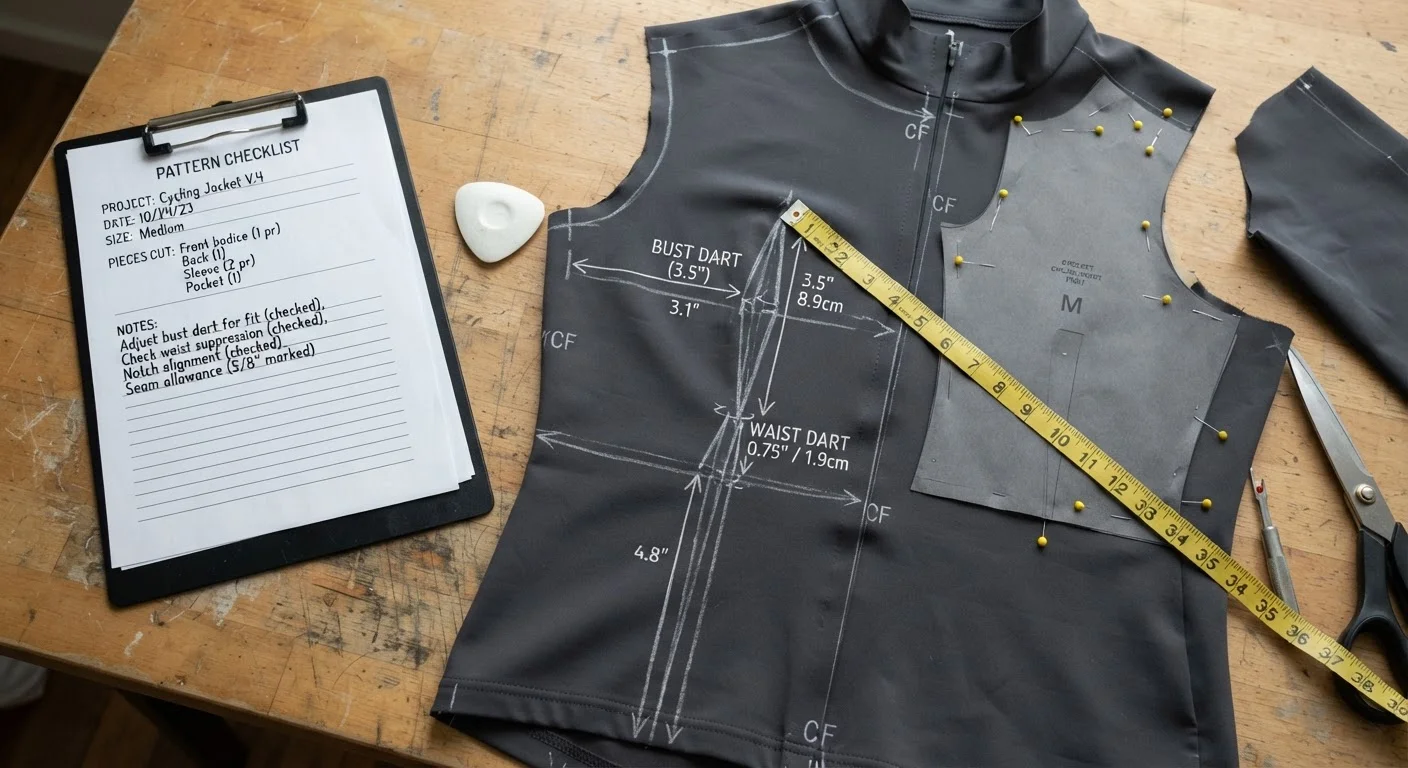
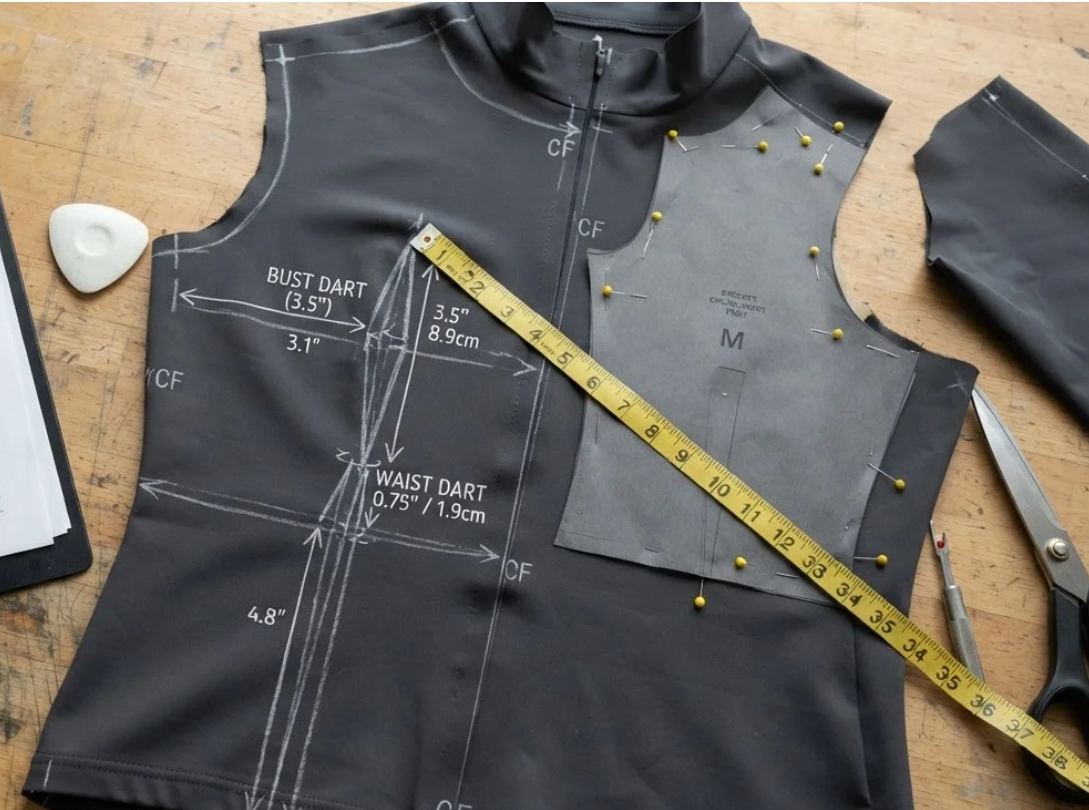
Ask any pattern engineer worth their salt for a number, and they'll give you one. Vague promises about "female-friendly fit" mean nothing at the cutting table. Real cycling jacket chest dart specifications start with an angle per dart of roughly 15°, distributed across two or three darts rather than crammed into one aggressive seam. The dart point itself also has rules. About 1 inch from the apex for smaller cup sizes, 2 inches or more for fuller busts, with the endpoint tapering off 1/2 to 1 inch before the fullest curve to prevent puckering under a jersey. One bodice reference even sets dart depth at a flat 1.5 inches, with bust dart length running at 85% of the design value.
Waist suppression works the same way, never a single blunt intake. A tapered dart running 1.5 inches at one point down to 0.5 inch at another on the same shaping line follows the body instead of fighting it, something a straight men's-block dart can't do.
Sleeve proportions need their own math. A common construction rule sets sleeve draft length at half the sleeve length minus 2 inches (5 cm), with bicep ease built in at half bicep plus 3/8 to 3/4 inch, depending on riding-position fit target. Measurement runs shoulder point to wrist, arm slightly bent, the position a rider actually holds on the bars, not a flat-arm mannequin pose.
These are the female athlete cycling wear specifications any competent custom cycling apparel manufacturer should hand over without hesitation when asked.
Layering System Design: Female-Specific Thermal Regulation and Ventilation
Physiology writes the layering brief before any fabric gets cut. Women typically produce less metabolic heat than men, which translates into lower skin temperatures and less heat loss through sweat evaporation under the same riding conditions. Cold-sensitivity studies confirm this: women register lower overall skin temperatures than men, particularly at the hands, feet, and lower body. A women's cycling jacket features list that ignores this data is building a layering system for the wrong body.
Base Layer: Moisture First, Warmth Second
The base layer's job is wicking, not insulating. It needs direct skin contact, snug but flexible, because loose fit creates air gaps that kill wicking efficiency. Polypropylene earns its place here because it's hydrophobic and moves sweat outward fast. One women's cycling brief formula runs 91% polypropylene / 9% elastane, a ratio worth benchmarking against any manufacturer's proposed spec.
Ventilation Zones: Where Air Movement Actually Matters
Ventilation isn't decorative mesh. Air movement can cut clothing insulation by 5% to 50%, and layered ensembles show it: heat exchange potential jumps from 17 W/m² in a single layer to 161 W/m² across three layers. Human testing pins optimal under-garment ventilation at roughly 24.5°C airflow and 1.56–1.68 m/s speed, with the lower back and chest flagged as prime ventilation zones. In heat, neck openings outperform hem openings for heat release.
The Design Split That Follows
More ventilation and heat release belongs at the chest, upper torso, and lower back. More insulation and wind-blocking belongs at the hands, feet, and lower body. That's the female-specific layering logic — not a men's shell with vents added randomly.
Pocket Placement, Collar Construction, and Adjustable Hem
Small details separate a jacket that survives daily riding from one that gets returned after a month. Pocket placement is the first tell. Generic construction guides put chest pockets 5.5–8 inches down from the shoulder seam and 4–6 inches in from center front — a spec built for a flat male chest, not a female one. On a women's cycling jacket, that same placement sits directly over bust tissue, which means pocket openings gape or press uncomfortably against the body. A Custom Women'S Cycling Jackets factory that understands female cycling jacket pattern work marks pocket location on a fitted mannequin first, checks it against the bust apex, and adjusts before cutting — not after complaints arrive.
Construction quality matters as much as placement. A properly built patch pocket uses a double-folded top edge, pressed side folds, and a 1/2 inch seam allowance, with a fusible interlining rectangle behind any pocket opening wider than 12 cm to stop stretching under load. That matters when a phone or gel packs sit against a moving chest wall.
Collar and hem checkpoints:
Collar stand alignment should match front placket buttonholes exactly — a quick quality-check any buyer can verify on a sample
Collar edges pressed on the foldline, pivot-stitched, then topstitched clean
Hem allowance left foldable, adjustable before final stitching rather than fixed length
These are where gender specific cycling gear either proves its engineering or exposes a relabeled men's block.
Three Common Quality Failures When Using Men's Patterns for Women's Jackets
The grading math tells the story.
Failure 1: Shoulder Slope and Width Mismatch
Women's grading adds 0.3 cm (1/8") of shoulder length per size step and about 0.6 cm (1/4") of back width per step. That's a fraction of what a men's block uses. Skip this rebalancing and you get visible pulling across the upper back, a droopy shoulder seam, and a collar that floats off the neck instead of sitting flush.
Failure 2: Armhole and Sleeve Cap Distortion
With women's bodice grading, a separate vertical reference line runs through the armhole near the side seam, and the increments dwarf the shoulder numbers. One grading guide lists a 14.4 mm armhole increment against just 8 mm at the shoulder. Copy a men's armhole shape onto that frame and riders lose arm lift, get wrinkling across the upper chest, and feel restricted reach on the bars.
Failure 3: Bust and Waist Shaping Left Unredistributed
At both bust and waist, commercial systems add about 2.5 cm (1") per size step, concentrated through the front bodice, not spread evenly across the whole shell. Skip that redistribution and you get excess fabric at the chest, front-opening gape, or a boxy silhouette with zero bust contour — the telltale sign of a resized men's pattern.
Custom Women's Cycling Jacket Technical Checklist: 8 Critical Specifications for Factory Negotiation
Print this list and bring it to your next factory call. These eight specs separate a manufacturer who engineers for women's bodies from one who's guessing.
1) Waterproof rating. Demand a hydrostatic head number in mm, not a marketing adjective. 5,000 mm is splash-resistant at best. 10,000 mm is the minimum for sustained rain. 20,000–30,000 mm is where a jacket earns "high-performance" status. Ask whether the rating applies to the fabric alone or the finished garment — those numbers diverge.
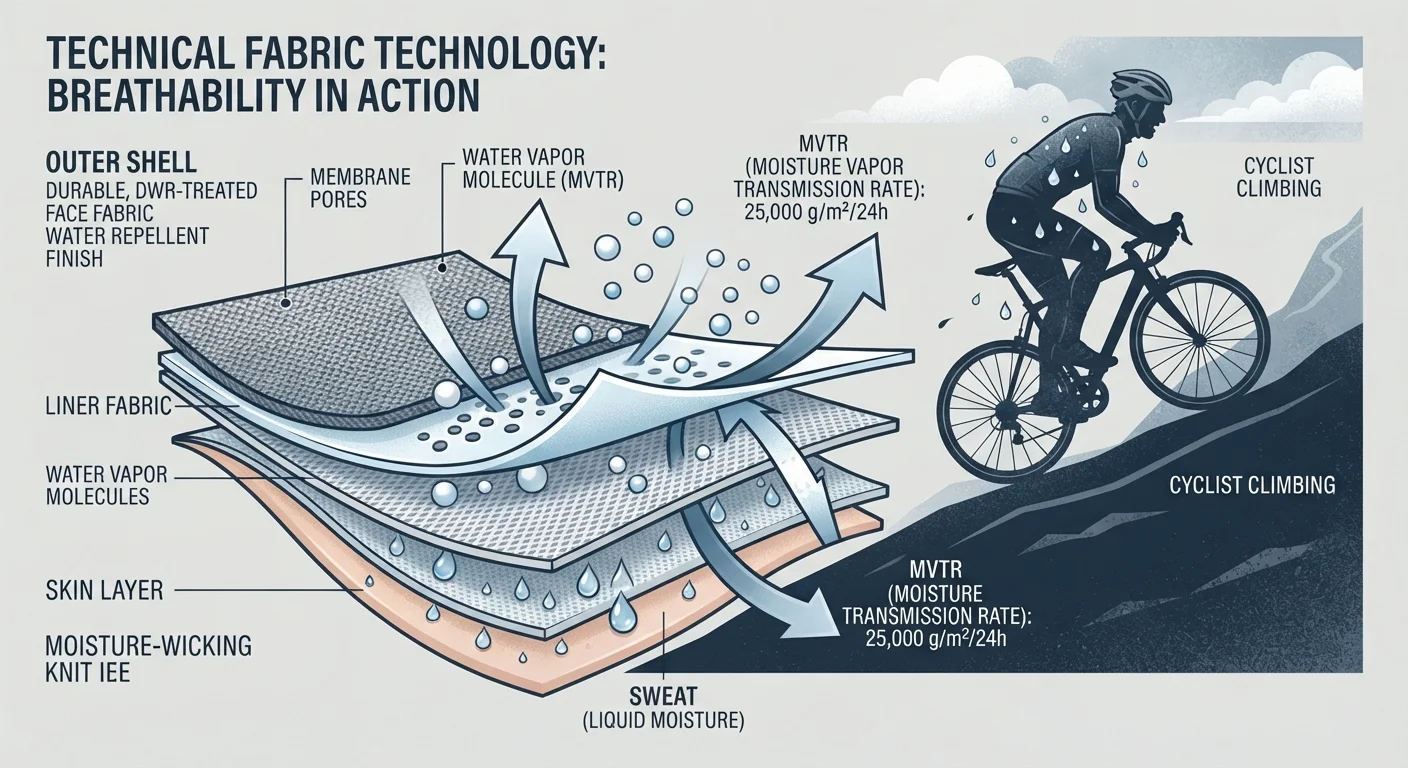
2) Breathability rating. Same rule, different unit: MVTR in g/m²/24h. Below 10,000 fails under hard pedaling. 10,000–20,000 is acceptable. 20,000–30,000 is strong. Request the lab standard used and whether it's membrane-only data.
3) Seam construction. Any jacket claiming 10,000 mm+ waterproofing needs fully taped seams. No exceptions.
4) Zipper spec. Weatherproof zips are baseline. Premium women's jackets run a 2-way front zipper for on-bike ventilation control.
5) DWR finish. Confirm a durable water-repellent coating on the outer shell — this is what sheds spray before the membrane ever engages.
6) Membrane/wind barrier. Ask about TPU or equivalent laminated windproof construction, not just "windproof fabric" language.
7) Graded sizing sheet. Require a full women's grade set — chest, waist, hem, sleeve, back length — across the size run, XXS–XL.
8) Reflective placement. Rear and side reflective elements aren't optional for road use.
Real Product Benchmarks Worth Comparing Against
Market references make negotiation concrete. GOREWEAR's Fernflow Thermo runs 91% recycled polyester / 9% elastane, 2-way zip, 25-inch back length, 14.08 oz. MAAP's Apex Winter Jacket 2.0 sits at 348g with a 53/33/14 polyester-polyamide-elastane blend for 0–12°C riding. Their lighter Prime Jacket drops to 180g for 12–20°C. Siroko's winter shell uses a 3,000mm TPU outer over micro-fleece — useful for gauging where budget builds cut corners.
MOQ Reality Check
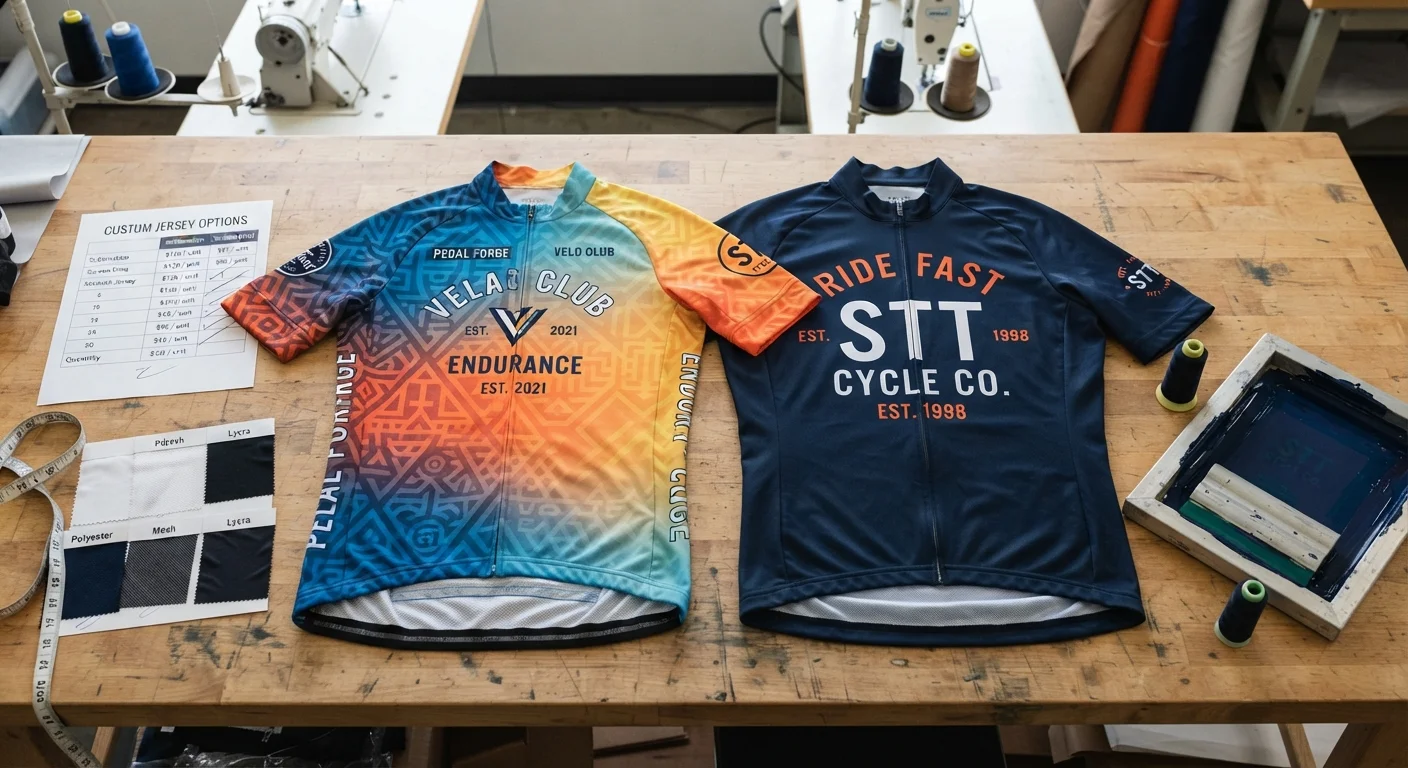
Factories rarely post MOQ publicly. Industry benchmark for small-batch technical garments: 100–300 pcs per colorway/style, lower for sublimated polyester, higher for fully laminated waterproof builds. Negotiate MOQ against fabric minimums and zipper sourcing, not unit count alone.
RFQ language to copy directly:
- "State hydrostatic head in mm and MVTR in g/m²/24h for the finished garment."
- "Confirm fully taped seams, DWR, and weatherproof zipper specification."
- "Provide a women's graded spec sheet with chest, waist, hem, sleeve, and back length."
- "Quote MOQ by color and total style, plus surcharge for seam-tape and waterproof zipper options."
Conclusion
An eight-degree miscalculation in chest dart angle or a two-centimeter oversight in waist suppression means return shipments and frustrated club members. That's the real cost of treating custom women's cycling jackets as a men's pattern shrunk down a size. A genuine women's cycling jacket cut specialist can walk you through their sleeve-to-torso ratio logic before you place a deposit.
Take this checklist into your next factory call. Ask for sample specs against each of the eight parameters. Request production data from previous female-specific runs, not just design sketches. If a Custom Women'S Cycling Jackets supplier hesitates on dart geometry or waves off waist-hip differential questions, you've found your answer and saved yourself a costly reorder. The right factory won't just accept your specs; they'll refine them.