You've narrowed it down to two jackets, but the spec sheets aren't helping. One brand claims "breathable," the other swears by "windproof," and neither tells you what actually happens when you're grinding up a hill at 8°C with sweat soaking through your base layer.
Softshell and windproof jackets solve different physics problems. A jacket rated for 15,000 MVTR won't perform like one built for 95% wind blockage. That gap decides whether you finish your ride comfortable or peel off a soggy layer at the summit.
This breakdown skips the fabric-101 talk and goes straight to the numbers: breathability rates, wind chill reduction, hydrostatic head—mapped against real scenarios like commuting, high-output intervals, and exposed mountain trails, so you can match the jacket to your actual sweat output and temperature range, not a guess.Brands developing performance collections often use custom cycling jacket manufacturer support for technical jacket production.
Breathability: MVTR Values (g/m²/24h) and How They Affect Sweat Management
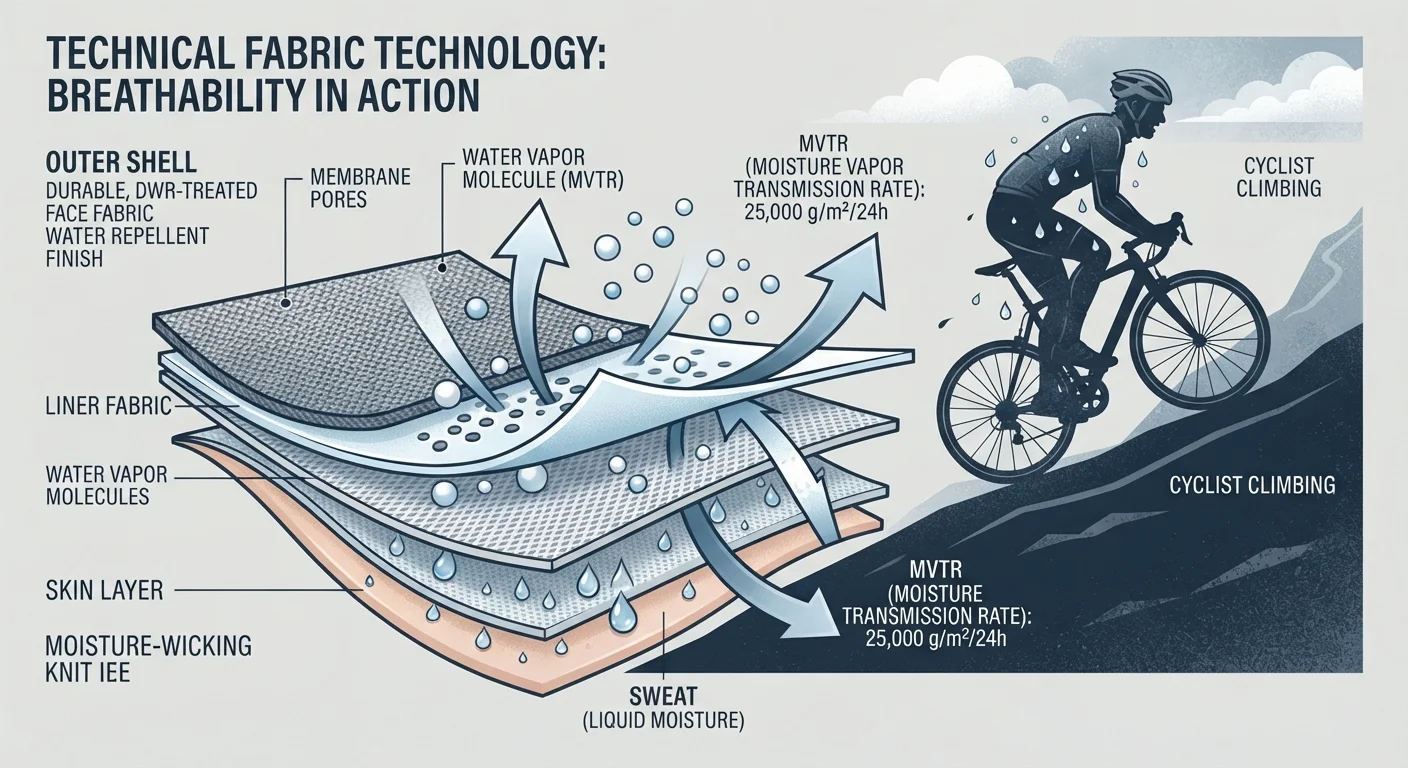
MVTR stands for Moisture Vapor Transmission Rate. It's the number that tells you how a jacket will feel two hours into your ride—grams of water vapor passing through one square meter of fabric over 24 hours. The higher the MVTR, the faster sweat vapor escapes, and the drier you stay next to your skin. Lower MVTR traps that moisture, letting it condense right where you don't want it.
Here is what these ranges mean for jacket shopping:
Under 5,000 g/m²/24h — poor breathability. Feels clammy the moment you push pace.
5,000–10,000 g/m²/24h — moderate. Fine for casual commuting or walking.
10,000–15,000 g/m²/24h — good. Works for hiking and moderate-intensity cycling.
15,000–20,000 g/m²/24h — very good. Built for high-output sessions.
Above 20,000 g/m²/24h — excellent. Meant for intense sports and mountaineering.
Around 40,000 g/m²/24h — the upper benchmark some outdoor guides cite for premium membrane technology.
Most technical outerwear membranes fall in the 8,000–15,000 g/m²/24h range. Some waterproof-breathable fabrics push 12,000–25,000 g/m²/24h without losing water resistance.
One catch: MVTR numbers aren't always apples-to-apples. ASTM E96 and JIS L 1099 test methods give different results for the same fabric, because humidity gradient, temperature, and cup orientation vary between labs. So when a brand quotes "15,000 g/m²/24h" without naming the test standard, treat that number with caution.
For sweat-heavy activities like running, hiking, or hard cycling intervals, target 15,000 g/m²/24h or higher. For light movement or short commutes, 5,000–10,000 gets the job done. And always ask Softshell And Windproof cycling jackets suppliers for the exact test method alongside the number, because that context changes what the figure means for your ride.
Windproofing: Air Permeability Ratings and Real-World Wind Chill Reduction
Air permeability and breathability are not the same thing. Mixing them up is where most buyers go wrong. The real test for wind chill factor cycling gear happens on an exposed ridge at 30 mph gusts, not in a lab spec sheet.
The industry measures this in CFM (cubic feet per minute) using ASTM D737 or ISO 9237. Air is pushed perpendicularly through fabric at a set pressure—usually 100 Pa for garments. Here's the scale that matters:
0–1 CFM — near-windproof. Membrane-backed shells sit here.
1–5 CFM — strong wind blocking. Most technical windproof jackets land in this zone.
5–10 CFM — very wind-resistant. This is where most softshells sit.
10–20 CFM — moderate resistance. Wind gets through on gusty descents.
Above 20 CFM — noticeable air passage. Fleece sits around 60 CFM, meaning wind cuts straight through.
A hard windproof shell rated ≤1 CFM blocks nearly all airflow. A softshell at 5–10 CFM lets some wind through—by design, since that same permeability is what lets sweat vapor escape.
A cold-weather clothing study backs this up: garments needed at least 10 CFM/ft² to hold "satisfactory" wind protection up to 9.6 mph. Below that threshold, wind chill starts eating into your body heat fast, especially on exposed climbs where speed drops and gust exposure spikes.
When sourcing jackets, ask cycling jackets suppliers for three things: the CFM value, the test method (ASTM D737 preferred), and the pressure it was tested at. "Windproof" on a tag means nothing without those numbers attached.
Water Resistance: Hydrostatic Head (mm) and DWR Performance for Intermittent Rain
A jacket's water resistance and windproof rating tell two different stories. Windproofing blocks air. Hydrostatic head (HH) measures how much water pressure a fabric can take before it soaks through. It's tested in millimeters by pushing a column of water against the fabric until it leaks.
Here's the practical scale for intermittent rain:
0–1,500 mm — water resistant only. Handles a light spritz, nothing more.
1,500–5,000 mm — dry brief showers, urban commuting. EQUIDRY calls this "waterproof for light-to-average rain." Finisterre labels anything under 10,000 mm as drizzle-grade.
5,000–10,000 mm — the working range for regular intermittent rain. Windrider pegs 5,000 mm as light-to-moderate rain, 10,000 mm as moderate-to-heavy.
10,000–20,000+ mm — extended exposure, wind-driven rain, wet snow. This is Finisterre's minimum rainproof threshold and the zone most guides call "good outdoor clothing."
DWR (durable water repellent) is a separate layer. It's a coating on the face fabric that makes water bead and roll off instead of soaking in. It buys you time during short showers. Once the outer fabric wets out, breathability drops fast and the jacket starts feeling clammy no matter what the HH rating says. DWR degrades with wear and washing, so reproofing is required upkeep.
For real-world buying decisions:
DWR + 5,000–10,000 mm HH — practical minimum for daily commuting through intermittent rain.
DWR + 10,000–15,000 mm HH — safer pick for wind-driven showers or longer exposure on exposed trails.
Ask for the HH number and the DWR treatment name separately. A professional OEM cycling clothing supplier can provide fabric testing data before bulk production.A high HH rating with a dead DWR coating still leaves you soaked from the outside in.
Insulation and Layering: How Fabric Construction Determines Warmth Without Overheating
Warmth comes down to four variables: thickness, trapped still air, external wind, and moisture content. Miss one, and you freeze or cook inside your own jacket.
Thermal insulation resists heat transfer through conduction, convection, and radiation. But insulation alone isn't the goal. Moisture management matters just as much. Sweat vapor escapes through the tiny gaps between yarns and fibers. Block that pathway and heat builds up fast, causing the sticky, clammy feeling that ruins a ride.
The choice between insulation and a windproof jacket comes down to this: a pure windproof shell blocks air movement almost completely, trapping heat but also moisture. Softshells layer differently – less insulation, but better vapor pathways.
Clo values give you a baseline. 1 clo roughly equals a business suit at rest. Layering adds up, but returns diminish past 3 clo total. Stacking five thin layers rarely outperforms three well-chosen ones.
The Layering System That Works
Many brands choose ODM cycling clothing services to develop seasonal layering systems faster.For a cycling layering system, the sequence matters more than any single garment. Start with a base layer that wicks sweat away from skin. Knitted polyester tested worse for cold sensation in comparative studies versus other synthetics, so check moisture-permeability specs before buying. Next, a mid layer of wool or synthetic insulation adds clo without blocking vapor transport. Finally, a shell – windproof or softshell, depending on your temperature range and sweat output.
Skip the base layer, and even a high-MVTR shell won't save you. Damp skin against fabric triggers the cold, clingy feeling riders complain about most.
Mobility and Fit: Stretch, Cut, and Packability for Active Movement
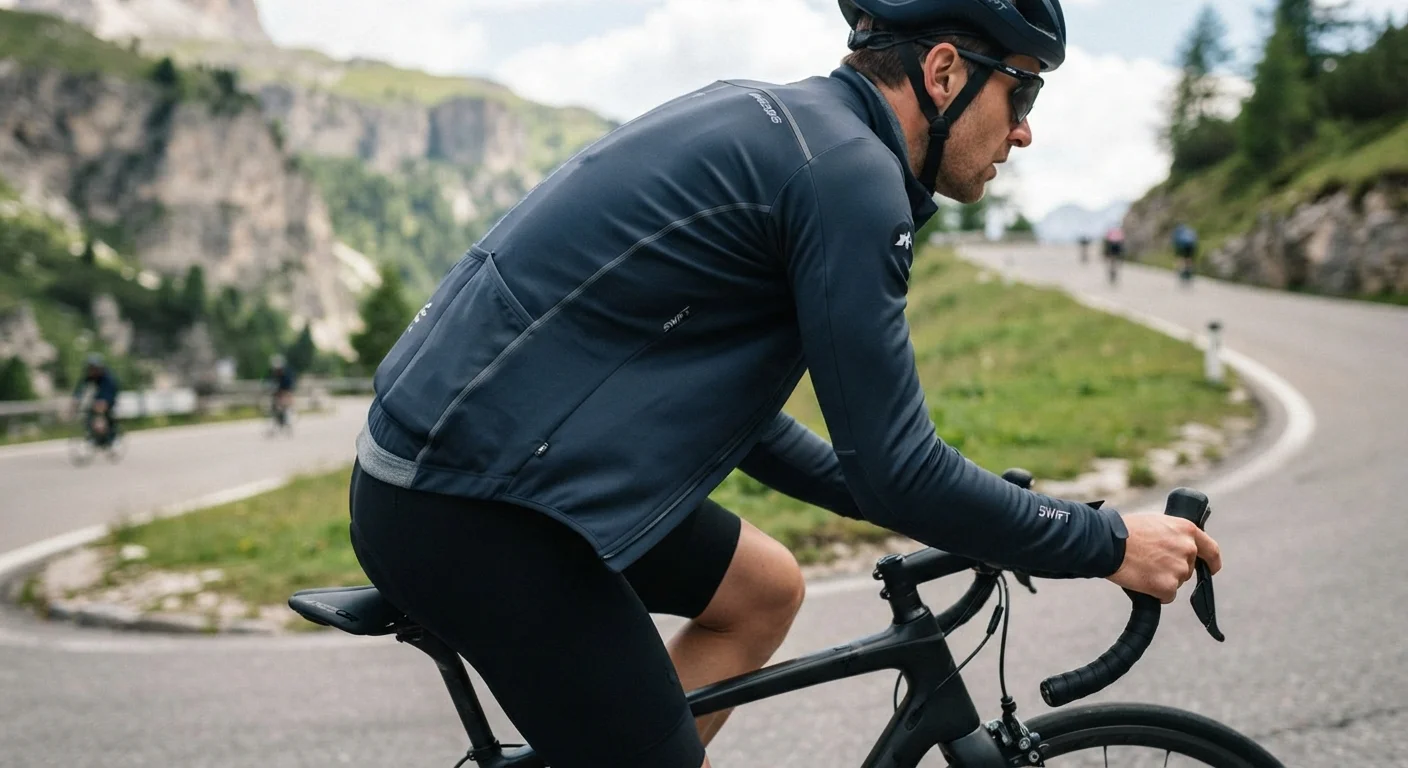
Fabric spec sheets rarely mention what happens when you reach forward on the drops or swing a leg over the top tube mid-climb. That's where stretch percentage and seam placement decide whether a jacket moves with you or fights you.
Most stretch fabric cycling jackets use a nylon or polyester base blended with spandex, elastane, or Lycra. The spandex percentage changes the feel entirely:
10–18% spandex — the sweet spot for running and gym-style movement, balancing stretch with durability
12–15% spandex — tuned for yoga and lifestyle flexibility
20–25% spandex — compression-grade, built for tighter fit and support rather than free range of motion
For cycling specifically, jackets in the 10–20% elastane range give most riders what they need: enough give to reach the bars without the fabric snapping back too aggressively.
Two-Way vs. Four-Way Stretch
2-way stretch moves in one direction only, usually from side to side. 4-way stretch moves horizontally and vertically, which is what you want when you're hinged forward in an aggressive riding position for three hours straight. High-mobility activities like intense training and running use 4-way construction because your body doesn't move in one plane, and your jacket shouldn't either.
Elastane-based fabrics can stretch up to 500% of their original length and snap back to shape. That recovery rate keeps a jacket fitting the same way after your fifth hard interval as it did on the first.
Cut and Seam Placement
Fabric alone doesn't guarantee mobility. Pattern cutting does the rest. Three construction details reduce restriction in contoured activewear:
Fewer seams across high-movement zones
Strategic seam placement away from joints and pivot points
Grainlines aligned to body movement , not just fabric economy
Some designs go further, combining the body and sleeve into a single piece with bias-cut panels at the shoulders, exactly where cycling posture demands the most freedom. Fewer sewn parts means fewer places for the jacket to bind when you're reaching or twisting.
Packability
For commuters and long-distance riders carrying a jacket rather than wearing it all day, packability matters as much as stretch. Compact, fold-flat designs that stuff into a jersey pocket or saddle bag without bulk are now standard in travel-oriented outerwear. If you're choosing between two jackets with similar stretch specs, the one that packs smaller wins for anyone doing mixed-mode commutes.Comparing custom wholesale price for cycling jacket helps buyers balance fabric performance and order volume. You wear it downhill and stash it on the climb.
Scenario Performance: Commuter Riding, Long‑Distance Hiking, and High‑Intensity Intervals
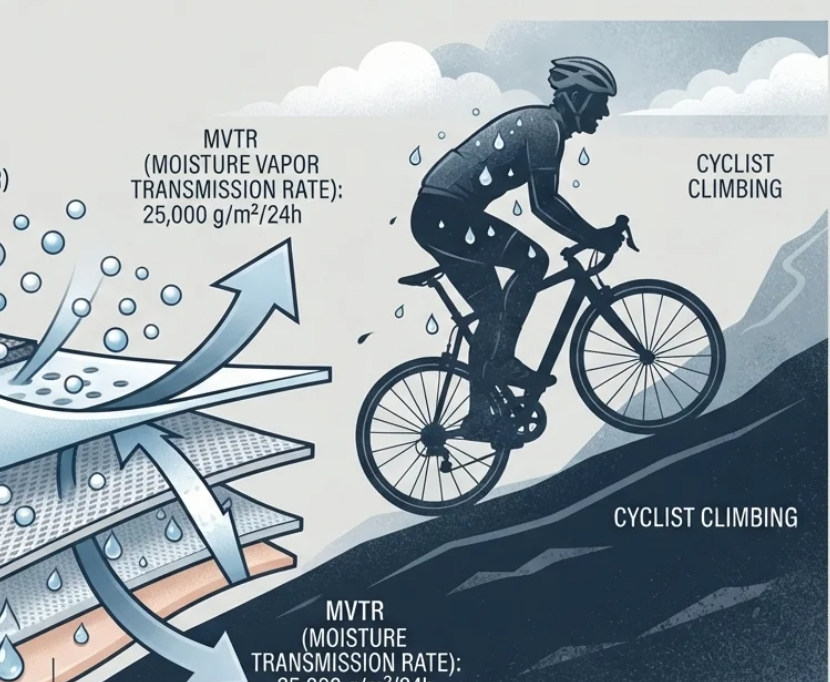
Your sweat rate depends on effort, not fabric. A 30-minute commute at 10–12 mph burns roughly 200–350 calories. Push the pace to 14–16 mph and that climbs to 300–390 calories in the same window, or 600–850 kcal/hour depending on weight and grade. That's the moisture load your jacket has to manage before you even factor in outside temperature.
Commuter riding sits in the light-to-moderate aerobic zone. Casual pace under 10 mph barely raises core temperature. City riding at 10–12 mph produces steady, manageable heat output. Here a softshell's 5,000–10,000 g/m²/24h breathability and moderate wind resistance work fine – you're not generating enough heat to overwhelm the fabric, and you get better mobility for stop-and-go traffic.
Long-distance hiking runs on a different clock. Naismith's Rule – 1 hour per 3 miles plus 1 hour per 2,000 feet of ascent – shows why pace matters more than raw speed. Easy trails at 1.5–2.0 mph with 300+ ft/mi gain cause minimal slowdown. Moderate terrain at 2.0–2.5 mph with 400–500 ft/mi drops speed 20–30%. Difficult terrain over 500 ft/mi can slow you 40–80%. That variable effort means variable sweat output, and it's why a layering system built around a wicking base and adjustable shell beats a single fixed-insulation jacket here.
High-intensity intervals demand the most from breathability. A 4×4-minute protocol at 85–95% max heart rate, or 10×1-minute bouts at 80% peak power, generates continuous heat spikes with almost no recovery window. RPE 17 during work intervals means you're sweating hard, fast. This is the scenario where a windproof jacket without a high MVTR rating turns into a sauna. You need 15,000 g/m²/24h or higher, or you're better off skipping the shell for a wicking mid-layer alone until you cool down.
The pattern holds across all three: intensity dictates breathability need, terrain dictates layering flexibility, and speed rarely tells the full story.
Decision Tool: Match Your Jacket to Activity Type, Temperature Range, and Sweat Output
Your activity type, the temperature range you'll ride or hike in, and how much you sweat doing it settle this. Skip the marketing copy and run your situation through this matrix instead.
Your Situation | Temperature Range | Jacket Choice |
|---|---|---|
High-sweat output (running, uphill hiking, intense intervals) | Any cool range | Maximum breathability shell, ≥10,000 g/m²/24h MVTR minimum, 20,000+ for serious runners |
Moderate-to-high aerobic effort | Just above to well below freezing | Light insulated active jacket with stretch grid fleece at shoulders, sleeves, underarms |
Cool weather, high movement | 10–20°C | Windbreaker or light shell, ≥8,000 MVTR |
Mixed exertion, cool to cold | 5–10°C | Full-zip training jacket (200–300g), windproof panels + venting zips |
Cold, moderate activity | 0–5°C | Insulated jacket (350–450g), insulation plus windproof outer |
Below freezing, low output or stop-start | −5 to 0°C | Insulated jacket + shell system, 400–500g total |
Very cold, stationary or low activity | Sub-zero | 400g insulation for 15–30°F, 600–800g for single-digit/negative, 800–1200g+ for extreme cold |
If your activity changes mid-route, adjust before your body does. Base layer only on the climb, add layers before you stop moving at a summit, strip back down on the descent when exertion drops. In changeable 8–12°C conditions, carry a shell in your pack rather than committing either way.
Conclusion
When your rides regularly push MVTR above 5,000 g/m²/24h in sweat output, a softshell's stretch and breathability keep you comfortable longer than any windproof shell can. Drop below 10°C with gusty conditions, and that same softshell turns into a wind tunnel against your chest. That's when you need a true windproof membrane in your cycling layering system.
There's no universal winner here—only the right tool for your specific combination of temperature, intensity, and exposure. Pull up the scenario table above, match it against your typical ride or hike, and check the exact air permeability and hydrostatic head ratings on any jacket before you buy, not just the marketing copy.Working with a reliable performance cycling apparel manufacturer helps brands maintain consistent quality across future collections.