A team manager sends out RFQs for matching jerseys and bib shorts, expecting the pricing to scale proportionally. Then the quotes come back — the bib shorts cost 30-40% more per unit, with a lead time that's nearly double. Is the custom cycling bib shorts factory padding the invoice, or is something real driving that gap?
It's real, and it's a stack of technical decisions jerseys don't require. Chamois pad selection and testing, compression fit engineering across multiple body zones, leg gripper construction, three-dimensional pattern making instead of flat-cut panels — each adds cost, time, and failure points a jersey never touches.
This breakdown walks through where those costs come from, what "good" construction looks like on the production floor, and the specific questions that separate a factory that understands custom bib shorts from one that's guessing.
A Custom Bib Short Costs 15–50% More Than a Custom Jersey. Here's Why.
Numbers tell the story better than adjectives. Look at any manufacturing quote sheet side-by-side. The gap between a jersey and a bib short is structural.
The pattern holds across factories and regions.
A China-vs-Europe manufacturing comparison lists basic jerseys at $12–18 against entry bib shorts at $18–28. Move up a tier, and mid-tier jerseys run $22–35 while premium bib shorts hit $35–55.
European factories show the same spread at higher absolute numbers: basic jerseys $35–55 vs. entry bib shorts $45–70, and mid-tier jerseys $60–95 vs. premium bib shorts $85–140.
Retail-facing custom programs confirm it. Tineli's top-tier custom pricing has a Pro Aero Jersey at $140.90 next to a Pro Elite Bib Shorts at $170.10. Another supplier's volume-break sheet shows road tops dropping to $55 at 30+ units, while Road Bib Top Shorts stay at $95 at the same volume.
Small orders widen the gap. One custom cycling apparel supplier quotes an MOQ of 5 units, with jerseys at €48 and bib shorts at €69, before a flat €150 project fee for 3D mock-ups gets split across the order. At 5 units of each, that's €735 total, and the bib shorts alone carry roughly 44% more per-unit cost than the jersey.
Where the Extra Dollars Actually Go
The chamois pad is the single line item jerseys never have. Marketplace listings for custom bib shorts routinely sit at $16.88–28.50, and standalone chamois sourcing runs $19–25. That's before labor to bond, stitch, and pressure-test the insert into the panel structure.
Volume doesn't erase this. Premium bib pricing drops from $69 at 10 units to $35 at 200, but even professional-grade shorts without a full bib design still add $10 just for the strap conversion.
If a custom jersey quotes at $20–35, expect the matching bib short to land at $28–55. That 15–50% premium shows up in nearly every factory's pricing band, regardless of region or MOQ.
The Extra Technical Layers That Don't Exist on a Jersey
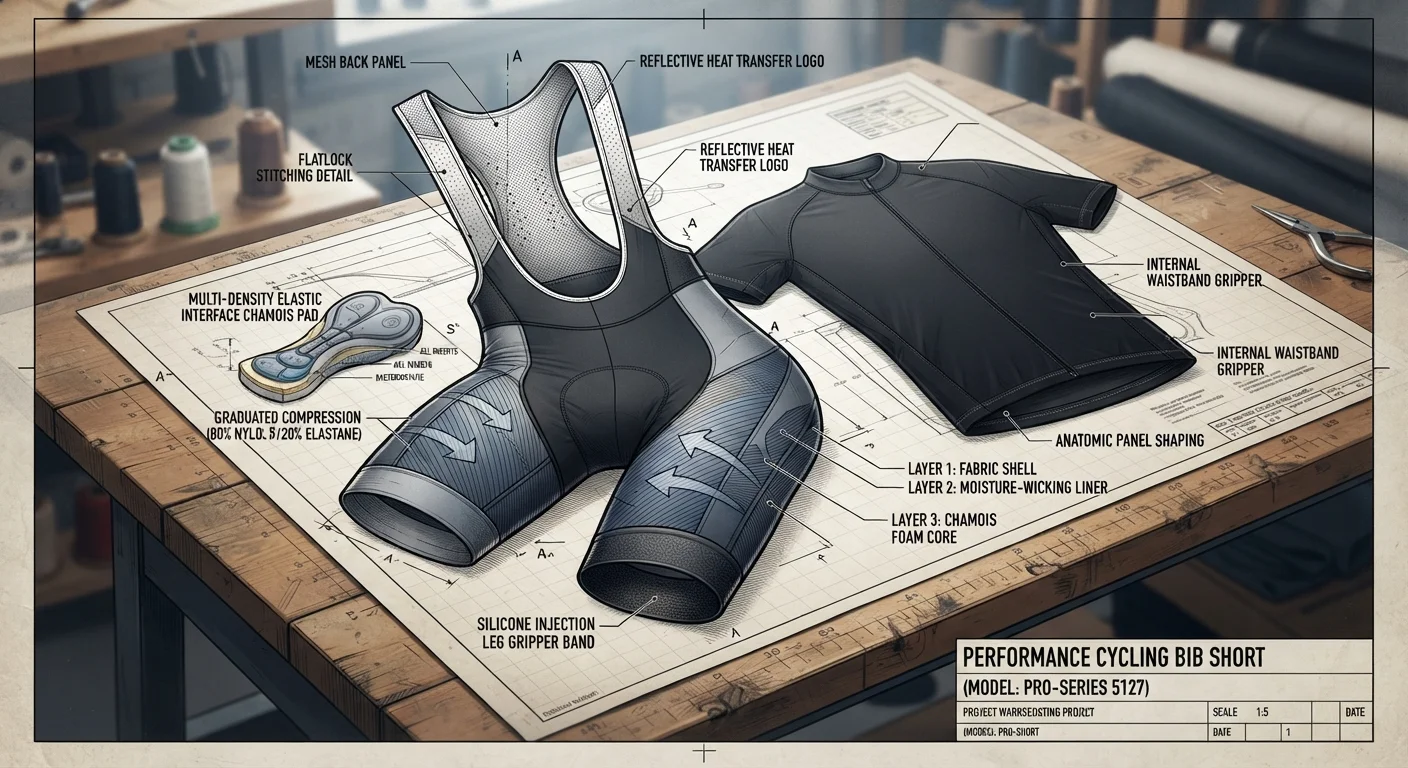
Strip a jersey down to its fabric spec sheet, and you're looking at a single layer doing one job. Bib shorts stack multiple functional layers on top of each other, each solving a different problem, and each adding a construction step a jersey pattern-maker never has to think about.
Single-Layer Knit vs. Multi-Layer Build
Jersey fabric selection means picking one knit and moving on. Tests on a 96% cotton / 4% spandex blend and a 70% polyester / 26% rayon / 4% spandex blend confirm these are single-layer constructions. Thinner jersey knits breathe better; thicker ones wick more efficiently. But it's one fabric layer, one decision, one panel.
Bib shorts don't work that way. The chamois pad alone is a bonded multi-layer assembly: a moisture-wicking face fabric, a cushioning core, and a base layer bonded to the short's panel. Structurally, that's closer to a 3-layer shell build (outer fabric plus functional membrane plus bonded inner layer) than anything a jersey requires.
Where Compression Fabric Borrows From Technical Apparel
Compression fit bib shorts now use bi-component knits, the same category as Polartec Power Dry for moisture wicking or Power Grid for thermoregulation. These knits move sweat through two distinct fiber layers instead of one, which is why compression fabric costs more per meter than standard jersey knit and requires different sewing tension to keep the compression gradient intact.
Leg gripper design works the same way. Some factories use a 2.5-layer approach: a fine raised silicone pattern screened onto the fabric to grip skin without a separate gripper band, reducing bulk versus a bonded elastic strip. Others still use a bonded third layer for durability.
None of this exists on a jersey. A mesh side panel handles ventilation, full stop. Bib shorts manage moisture transfer, compression, and skin contact at the same time, three engineering problems layered into one garment.
How the Supply Chain Multiplies Costs: More Components, More Suppliers, Longer Lead Times
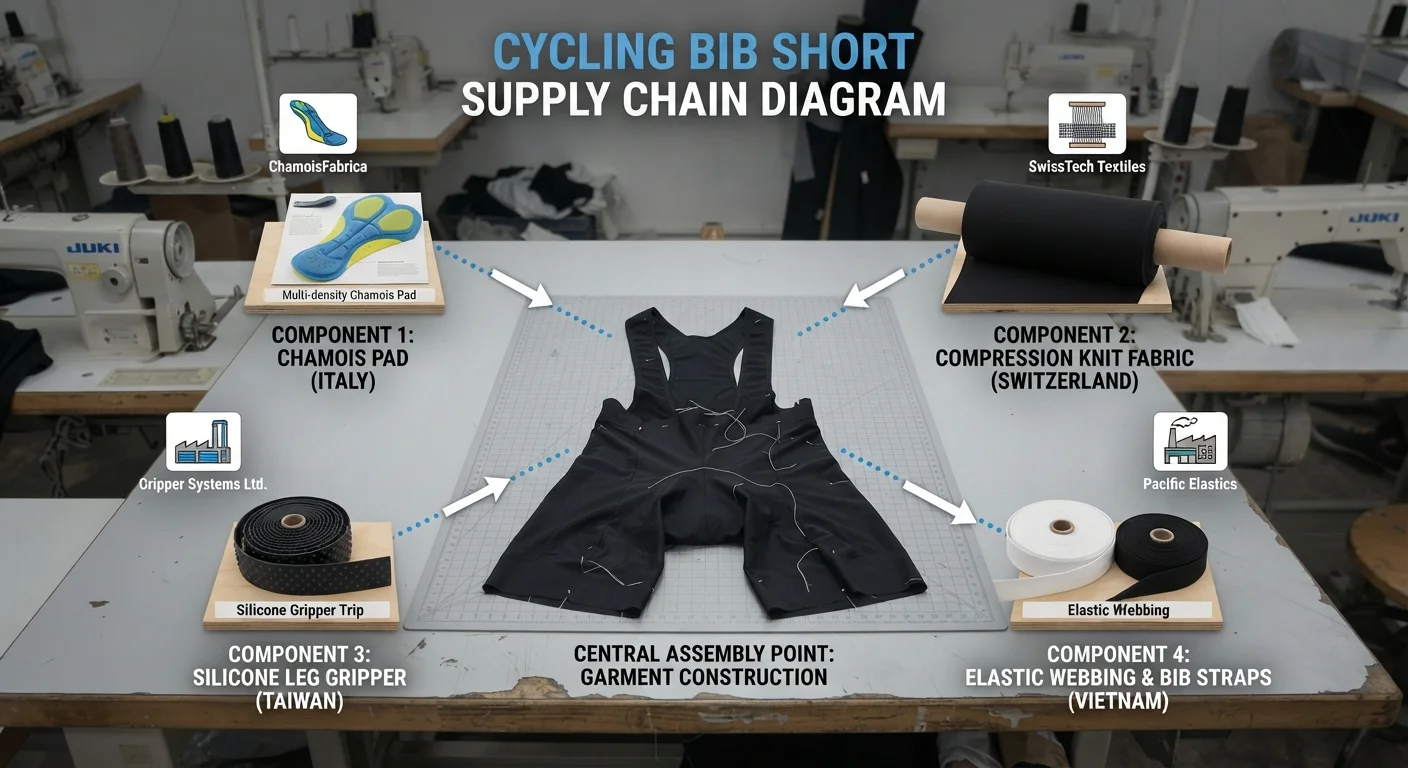
Every additional component in a bib short pulls in a new supplier, and every new supplier adds a coordination cost that compounds through the entire cycling apparel manufacturing process. A jersey routes through one fabric mill and one print shop. A bib short routes through a custom cycling chamois manufacturer, a compression-knit supplier, a silicone-gripper printer, and often a separate elastic-webbing vendor — four to five parties instead of one or two, each on its own production schedule.
This is a real cost driver. More suppliers means higher search, bargaining, and monitoring overhead, and that overhead lands directly in the unit price. Complexity also drives up transport costs, inventory financing, and the risk that one late component halts the whole line. If the custom cycling chamois supplier ships late, the entire bib short order stalls, even if every other piece is finished and waiting.
Lead time is where this bites hardest. Long, cross-border sourcing structures widen the gap between order placement and delivery, and that gap alone can add 20–30% to product costs through inventory financing. Companies that pushed international sourcing up by just 10% saw inventory investment costs climb 8.8% on average. Component lead times have swung wildly in recent years too — ISM data showed production-material lead times hit 88 days in mid-2021, the longest since 1987 record-keeping began, with some electronics components stretching from 16 weeks to over a year.
For a custom team cycling kit order, this means the bib short's slower, multi-supplier chain is the accumulated cost of coordinating four vendors instead of one, absorbing longer replenishment cycles, and carrying inventory risk a single-supplier cycling jersey never generates.
Production Workflow: How Many More Steps Does a Bib Short Require?
Count the stages on a cycling bib shorts factory floor and the answer becomes obvious fast. A full bib short production workflow runs 12 steps from tech-pack confirmation to final carton packing: tech pack, fabric/trim prep, PP sample, cutting, printing, heat sealing, sewing, pressing/finishing, QC, packaging, and final QC/carton packing. Total production time lands at 45–75 days.
Compare that to a standard sewn bib-style garment built with a simple cut-sew-turn-topstitch flow: cut the pieces, sew around the edges leaving a turning gap, turn right-side out, topstitch, then attach fasteners. That’s it. There’s no heat sealing, compression-zone sewing, or multi-pass QC.
Where the Extra Steps Live
The bib-short-specific complexity concentrates in three areas: heat sealing (bonding seams and panels without stitching that would irritate skin under compression), longer sewing time (20–40 days alone, the single biggest labor block), and more finishing and QC passes (final quality control at AQL 2.5, checked at carton packing).
That’s at least 3–5 extra manufacturing stages a basic short never sees. These include bib/strap pattern making, strap attachment or bonding, extra seam finishing via heat sealing, and more extensive fit and QC checks.
One in-house sportswear manufacturer puts it plainly: bibs and shorts require a skintight aerodynamic fit, which forces tighter pattern control and closer assembly coordination than any loose-fit garment demands.
For sourcing planning, treat this as a benchmark. Budget for one additional major assembly stream beyond standard shorts, with higher sewing minutes per unit and more in-line inspection points than a jersey or basic short ever requires.
Fitting Verification: 6 Inspection Points for Custom Bib Shorts vs. Jerseys
Six checkpoints separate a bib short that passes QC from one that gets returned by twenty riders after the first group ride. Jerseys have six checkpoints too, but they're testing different failure modes.
For custom bib shorts, check these in order: waistband tension (level, snug, no rolling), hip/seat coverage (no sagging in riding posture), thigh compression and hem grip (leg grippers stay flat, no creep during pedaling), chamois placement (centered, stable when seated, no folding when walking or squatting), strap lay-flat (flat across shoulders, no twisting), and a functional motion test on the bike to catch chafing or seam pull that static inspection misses.
Jerseys get verified through chest circumference, waist taper, sleeve/cuff fit, and back-hem drop coverage — checked standing and in riding posture.
The tolerance gap tells the real story. General jersey panels run about ±3 mm. Bib shorts' critical compression zones hold to ±2 mm, with single-size production dimensions on waist, hip, and inseam tightened to ±0.5–1.0 cm. That precision is why bib shorts fail inspection more often, and why sourcing teams need a stricter checklist before sign-off.
Supplier Due Diligence: Questions to Ask a Custom Bib Shorts Factory
Ten questions separate a cycling bib shorts factory that builds bib shorts from one that just sews shorts. Ask them before you sign a PO, not after the first shipment fails inspection.
MOQ and timeline: Confirm MOQ per style and per color. Expect 10-50 pieces, though 50 is the common industry benchmark. Ask for sample lead time (7-14 days) and bulk production timing (25-45 days). Vague answers mean the factory hasn't run bib shorts at scale.
Certifications and proof: Request current ISO 9001, OEKO-TEX Standard 100, and BSCI or Sedex certificates with valid numbers, specific to the bib shorts category. Ask for SGS or Intertek test reports covering moisture-wicking, UPF 50+, and crocking from the last six months.
Construction and capability: Verify they run flatlock, coverstitch, overlock, bonding, and bartack in-house. Ask if any cutting, sewing, or QC steps are subcontracted.
Verbatim questions worth asking:
What are your AQL thresholds and defect categories for bib shorts?
Which fabric mills and trim suppliers do you use — can we nominate our own?
Who is our daily contact, and what's the response-time SLA?
Get 2-3 references from cycling or performance sportswear clients before committing.
Conclusion
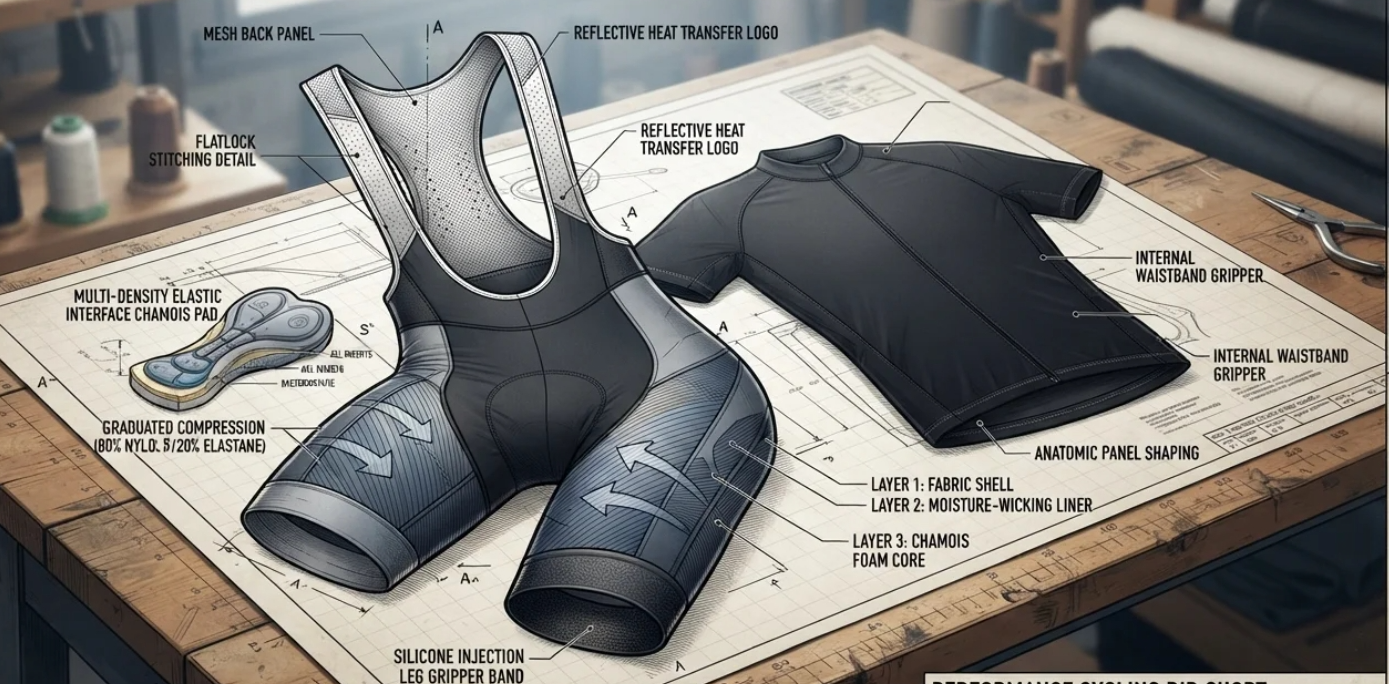
A jersey is a printed shirt. A custom bib shorts order is a wearable engineering project — cycling chamois pad customization, compression fit zoning, leg gripper welding, and multi-panel pattern making add 5+ extra production stages and drive costs 15-50% higher than jerseys. That price gap covers a garment built to survive 100km in the saddle without chafing.
If a supplier can't explain their chamois testing protocol, compression gradient data, or seam placement logic, they're guessing. Use the inspection checklist and supplier questions from this article to push back during negotiations, not just as a reference.
Before you sign off on your next kit order, request physical chamois samples and a sizing chart validated on real riders. Skip the spec sheet. That single step separates factories who understand cycling apparel from those who just sew fabric.